

Walter Ophey
Eupen
1882 -
Düsseldorf
1930
Walter Ophey, born at Eupen on 25 March 1882, was, with August Macke, Heinrich Nauen et al, a herald and leading exponent of "Rhineland Expressionism". In 1900 Walter Ophey began studying at the Düsseldorfer Art Academy and, from November 1904, he was in the landscape class taught by Eugen Dücker.
In 1908 the Düsseldorf painters Julius Bretz, Max Clarenbach, August Deusser, Wilhelm Schmurr and Walter Ophey formed a group called "Sonderbund", which would evolve into the most important German organisation mounting exhibitions of contemporary art.
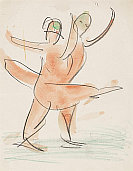
In parallel with the growing recognition accorded both Neo-Impressionist and Fauvist work, Ophey developed his own variant of "Rhineland Expressionism". A journey to Italy in early spring 1910 and a stay in Paris in autumn 1911 provided Walter Ophey with essential stimuli. Paris had such an impact on Ophey that it plunged him into a crisis and, forced him to deal with Cubism. The upshot was a redirection of Walter Ophey's work towards a more vibrant palette. Ophey began to develop a distinctively personal form of expression focused on linear drawings in coloured chalks.
After the first world war ended, Walter Ophey discernibly ordered his compositions more stringently and reverted to a more reticent palette, both departures that represented developments. In 1919 Walter Ophey was a driving force behind the foundation of the "Das Junge Rheinland" group, where he was on the jury judging the merits of works.
That same year Ophey was designated a member extraordinary of the Düsseldorf Art Academy. In 1922 Ophey played a paramount role in organising the "First International Art Exhibition" in Düsseldorf, at which he showed seven works. During the later half of the 1920s, Walter Ophey worked on the fresco "Der Sämann" ["The Sower"] for the Düsseldorf Planetarium, which was removed and destroyed by the National Socialists in 1937.
Walter Ophey died in Düsseldorf on 11 January 1930.

Would you like to sell a work by Walter Ophey?
Infos for seller


Starting bid: 9,000 EUR